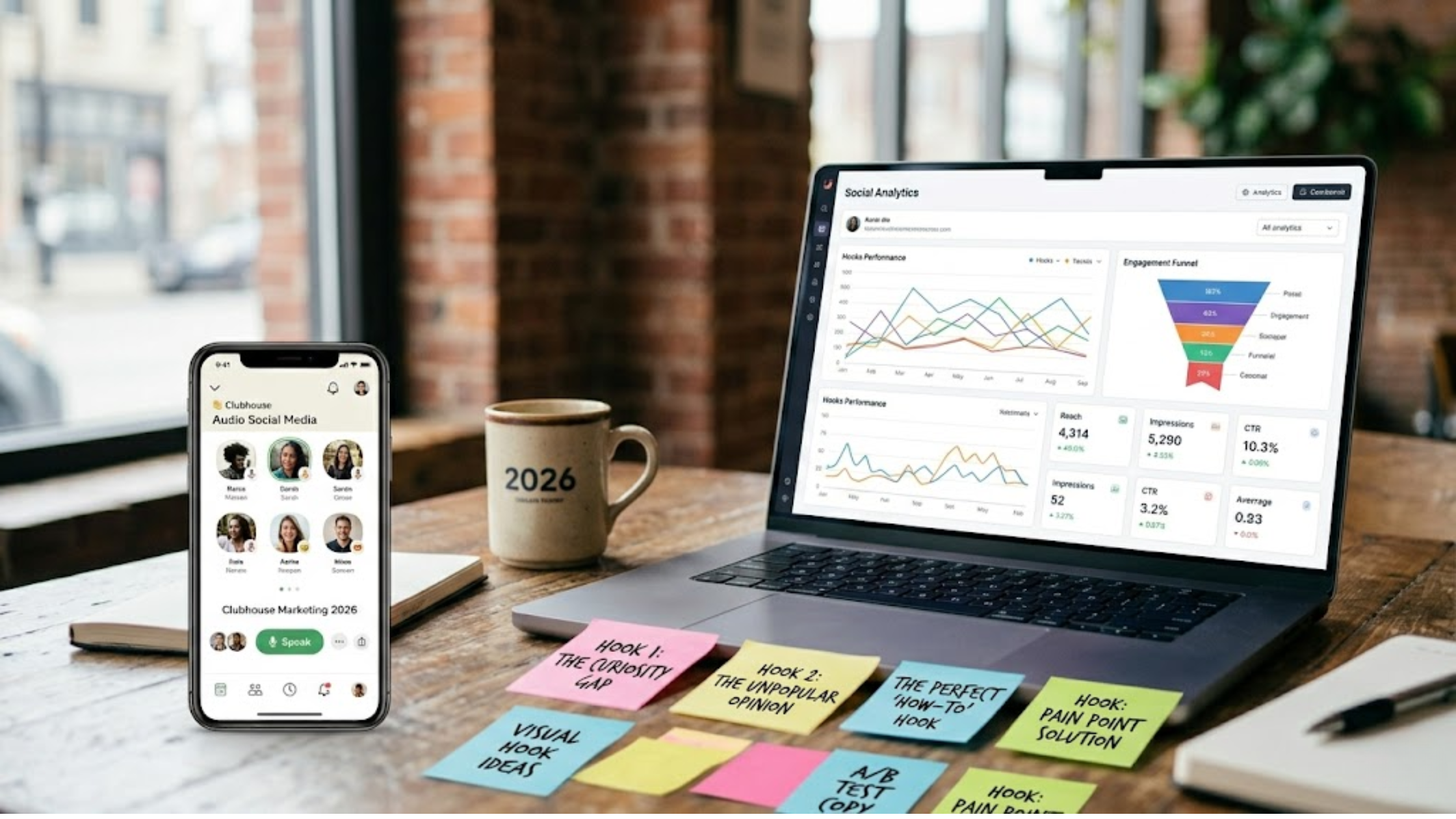
How to Write Social Media Hooks That Stop the Scroll and Drive Engagement
You have about 1.7 seconds.That is how long it takes someone scrolling through their feed to decide whether your post is worth their time. If your first line does not grab them in that window, they are gone and your content never gets a second chance.
This is why hook writing is the single most important skill for anyone who creates content on social media. It does not matter how good your caption is, how helpful your video is, or how beautiful your graphic looks. If the first line falls flat, none of that matters.
In this guide, you will learn exactly how to write hooks that work with real examples, simple formulas, and practical tips you can use starting today.
What Is a Social Media Hook and Why Does It Matter?
A hook is the opening line or the first few words of your post, caption, or video. Its only job is to make the person stop scrolling and want to read or watch more.
Think about how you use social media. You are moving fast, half-distracted, surrounded by dozens of posts competing for your attention. You do not read everything. You skim until something pulls you in. That pulling force is the hook.
On Instagram, TikTok, LinkedIn, and Facebook, algorithms reward content that gets engagement likes, comments, saves, and shares. But engagement only happens when people actually stop and read what you wrote. No hook, no engagement. No engagement, no reach.
The good news is that hook writing is a learnable skill. Once you understand a few core principles and patterns, you will be able to write better first lines every single time.
What Makes a Hook Actually Work?
The best hooks do at least one of these three things:
- They trigger curiosity. The reader wants to know what comes next.
- They create a knowledge gap. The reader feels like they are missing something important.
- They speak to a real pain or desire. The reader sees themselves in the words.
A hook is not a headline. It does not try to summarize your whole post. It is a door it just needs to get people to walk through it.
Here is a simple example. Compare these two opening lines for a post about saving money:
Weak hook: "Here are some tips for saving money."
Strong hook: "I saved $8,000 in one year on a $40,000 salary. Here is exactly what I stopped buying."
The second one creates a specific result, raises questions, and makes the reader curious about the method. That is what a good hook does.
6 Hook Writing Formulas That Work Across Every Platform
You do not need to reinvent the wheel every time you write. These proven formulas give you a starting point that you can adapt to your niche and audience.
1. The Bold Claim
Make a statement that is surprising, counterintuitive, or goes against what most people believe. This formula works because it challenges what the reader already thinks they know.
Example: "Posting more often is actually hurting your Instagram growth."
2. The Specific Number
Numbers feel specific and credible. They also signal to the reader that your content is structured and actionable not vague advice.
Example: "5 things I wish I knew before starting my freelance business."
3. The Direct Question
A question pulls the reader in because it invites them to answer it mentally. If the question is relevant to their life, they will keep reading to see what you say.
Example: "Are you making these mistakes with your morning routine?"
4. The Story Opening
Drop people right into a moment. No preamble, no setup just the scene. This is especially powerful on TikTok and Instagram Reels where the first frame needs to hook visually and verbally at the same time.
Example: "Last Tuesday, my client was about to quit. Then one email changed everything."
5. The Pain Point Mirror
Name the exact frustration your audience is feeling. When someone reads a hook and thinks "that is literally me," they will not scroll past.
Example: "If you are spending hours on content and getting zero engagement, this is why."
6. The Promise Hook
Tell people exactly what they will get from reading your content. Be specific about the outcome. Vague promises get ignored specific ones get clicks.
Example: "By the end of this post, you will know exactly how to write a caption that gets saved."
What Happens After the Hook - Making Sure People See It First
A great hook only works if people see it. On Instagram and TikTok, the algorithm decides how many people your content reaches based on early engagement signals. If your post gets strong initial views and likes in the first hour, the platform distributes it more widely - meaning more people see your hook in the first place.
This is why pairing strong hook writing with an initial engagement boost is such an effective combination. InstantLikes.us offers Free Instagram Views for Reels and video content, Free Instagram Likes for static posts, and Free TikTok Followers to build your baseline audience. All are completely free, require no password, and can be used immediately.
For creators operating from specific markets, our SMM Panel India and SMM Panel USA pages offer region-targeted engagement that makes your content feel locally relevant - a key factor in both algorithm performance and audience connection.
Hook Writing Tips for Instagram, TikTok, LinkedIn, and Facebook
The core principles of hook writing apply everywhere, but each platform has its own context and audience behavior. Here is what to keep in mind:
Instagram: Captions are cut off after two or three lines with a "more" button. Your hook needs to live entirely in those first visible lines. Keep it short, punchy, and specific. Emojis can help break up text visually and signal tone.
TikTok: The hook is both the caption and the first spoken words in your video. If you are on camera, say something in the first three seconds that gives people a reason to keep watching. Phrases like "you need to hear this" or "nobody talks about this" work well to create pattern interrupts.
LinkedIn: The audience here is more professional, but they are still human. First-person stories and honest observations tend to perform well. Start with a short single sentence, sometimes even a one-word opener like "Rejected." or "Fired." can be incredibly effective.
Facebook: Facebook users are slightly older on average and tend to read longer posts. Your hook can be a bit more conversational here. Starting with a relatable scenario "You know that feeling when..." tends to work well.
Common Hook Writing Mistakes to Avoid
Knowing what not to do is just as useful as knowing what to do. Here are the most common mistakes that kill hooks before they get a chance to work:
- Starting with your name or brand: "Hi, I am Sarah and I am a nutritionist" tells the reader nothing about what value they will get. Lead with the value first.
- Being too vague: "Some tips that helped me" says almost nothing. What tips? Helped you with what? Specificity is what creates curiosity.
- Clickbait without payoff: You can write wild hooks, but the content needs to deliver on what the hook promised. If it does not, people will stop trusting you and stop engaging.
- Making the hook about you instead of them: The reader's first thought is always "what is in this for me?" Your hook should answer that question immediately.
A Simple Way to Get Better at Writing Hooks Fast
The fastest way to improve your hooks is to write more of them. For every piece of content you create, try writing five different hooks before picking one. You will be surprised how much better your fifth attempt is compared to your first.
Also, start saving hooks that stop you when you are scrolling. Build a personal swipe file a notes app, a spreadsheet, or even a folder of screenshots. When you need inspiration, go back to that collection and look at what patterns show up.
Over time, you will start to internalize the rhythm and structure of a good hook. It becomes less like following a formula and more like a natural instinct. That is when your content starts to grow.
Final Thoughts
Writing a great hook is not about being flashy or tricky. It is about understanding your audience well enough to know what will make them pause. What are they struggling with? What do they want? What would surprise them?
When you answer those questions in your first line, you do not need tricks. You just need to be genuinely useful and a little bit bold.
The scroll never stops but with the right hook, neither will your readers.
1. How long should a social media hook be?
A hook should be short and instantly clear ideally one sentence or under 15 words. The goal is to grab attention quickly, not explain everything.
2. Can I use the same hook on every platform?
You can reuse the core idea, but it’s better to adapt it. Each platform (Instagram, TikTok, LinkedIn, Facebook) has a different audience behavior and tone.
3. How many hooks should I write before choosing one?
At least 3–5 hooks per post. Your first idea is rarely the strongest better hooks usually come after a few iterations.
4. Do hooks only matter for captions or also for videos?
They matter for both. In videos, the hook is often the first 1–3 seconds (visual + spoken), which is even more critical for retention.
5. What is the biggest mistake people make with hooks?
Being too vague or generic. Hooks like “Here are some tips…” don’t create curiosity or urgency, so people scroll past.
6. How do I know if my hook is working?
Check your metrics watch time, click-through rate, engagement (likes, comments, saves). A strong hook will noticeably improve these numbers.