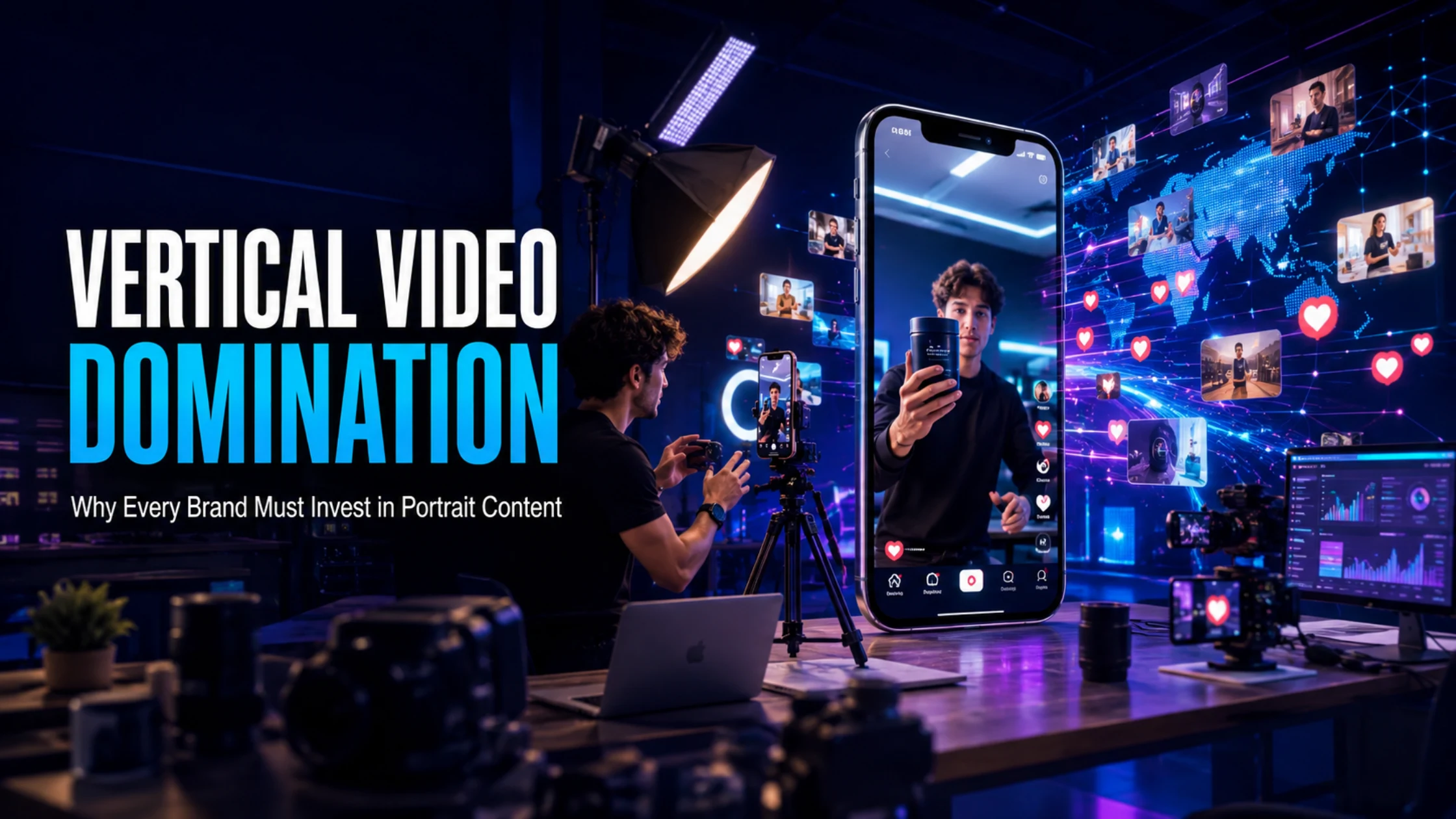
Vertical Video Domination: Why Every Brand Must Invest in Portrait Format Content
A few years ago, vertical video was the format brands tolerated because their audience happened to be scrolling on a phone. In 2026, that thinking is backwards. Portrait format isn't a compromise anymore — it's the default lens through which most people discover brands, products, and ideas online. If your content strategy still treats vertical video as an afterthought to a horizontal campaign, you're already behind.
This shift isn't just a creative preference. It's driven by how platforms rank content, how attention spans behave, and how algorithms decide what deserves a second look. Understanding why vertical video won, and how to build a real strategy around it, is now a core part of staying visible in search and social feeds alike.
The Vertical Video Shift Nobody Can Ignore Anymore
Mobile screens are portrait by default, and so is the way people hold their phones roughly 94% of the time. Platforms noticed this years ago and quietly rebuilt their entire content ranking systems around full-screen, vertical viewing. TikTok normalized it, Instagram followed with Reels, and YouTube pushed Shorts hard enough that even long-time horizontal-format creators had to adapt.
The result is a feedback loop. Vertical content gets more screen real estate, more completion views, and more algorithmic favor, which means platforms surface it more often, which trains audiences to expect it, which pushes brands to produce more of it. Horizontal video hasn't disappeared, but it now occupies a smaller, more specific role: long-form YouTube, webinars, and connected TV.
Why Portrait Format Outperforms Horizontal in 2026
A few structural reasons explain why vertical consistently wins on engagement metrics:
- Full-screen immersion: there's no letterboxing or wasted space, so every second of the video commands the entire viewport.
- Thumb-stop design: vertical video is built for interruption-based scrolling, where the first one to two seconds decide whether someone stays or swipes.
- Native platform behavior: TikTok, Reels, and Shorts all reward content that feels shot for the platform rather than repurposed from a TV ad or landing page video.
- Lower production friction: vertical content can be filmed on a phone with minimal setup, which means brands can publish more frequently without ballooning production costs.
Together, these factors mean vertical video isn't simply a stylistic choice, it's a measurable performance advantage in watch time, shares, and reach.
How TikTok, Instagram Reels, and YouTube Shorts Are Reshaping Discovery
Search behavior itself has changed. A growing share of product research and brand discovery now starts inside these three apps instead of a traditional search engine. Younger audiences in particular treat TikTok and Reels as a search bar, typing queries directly into the app to find reviews, tutorials, and recommendations.
This matters for SEO teams because it means visibility now spans two systems at once: traditional search rankings and in-app discovery algorithms. A brand that only optimizes for Google is leaving an entire discovery channel untouched. Vertical video, tagged and captioned well, effectively becomes a second search listing.
YouTube Shorts adds another layer, since it can also feed into a channel's broader authority and watch-time signals, indirectly supporting the same channel's long-form SEO performance.
What Vertical-First Content Actually Looks Like
Vertical-first doesn't mean cropping an existing horizontal ad into a 9:16 frame. Content built specifically for portrait viewing tends to share a few traits:
- A hook in the first two seconds, delivered visually, not just verbally.
- On-screen text and captions, since a large share of viewers watch with sound off.
- Fast pacing with cuts every few seconds to match scroll-driven attention.
- A single, clear idea per video rather than multiple messages competing for attention.
- A natural, unpolished tone that fits the platform rather than looking like a repurposed commercial.
Brands that repurpose old horizontal ads by simply adding black bars almost always underperform brands that shoot native vertical content, even when the native version has a smaller budget.
Building a Vertical Video Strategy at Scale
The brands winning with vertical video in 2026 treat it as a production system, not a one-off campaign. A workable structure usually includes:
1. A content pillar framework
Group videos into three or four recurring themes, such as behind-the-scenes, product education, customer stories, and trend commentary, so the content calendar doesn't rely on constant new ideas.
2. Batch production
Filming multiple videos in a single session, then editing and scheduling them across the following weeks, keeps output consistent without requiring daily shoots.
3. Platform-specific editing
The same raw footage can be cut differently for TikTok, Reels, and Shorts, adjusting pacing, captions, and calls-to-action to match each platform's audience behavior.
4. Repurposing into other formats
Strong-performing vertical clips can be repackaged into blog content, email snippets, or paid social ads, extending the value of each shoot well beyond the original post.
Common Mistakes Brands Make With Vertical Video
- Treating it as a lower-priority format compared to the website or paid search budget.
- Posting inconsistently instead of committing to a regular publishing cadence.
- Over-polishing content until it no longer feels native to the platform.
- Ignoring captions, keywords in on-screen text, and video descriptions, all of which affect in-app discoverability.
- Measuring success only by follower count instead of watch time, shares, and saves.
Getting Started: A Practical Checklist
- Audit your last 90 days of video content and identify how much was shot vertically versus repurposed from horizontal formats.
- Pick three content pillars your brand can sustain without running out of ideas.
- Set a realistic weekly or biweekly publishing cadence and stick to it for at least eight weeks before judging results.
- Write captions and on-screen text with your target keywords included naturally.
- Track watch-time and completion rate alongside traditional engagement metrics.
Vertical video works best as part of a wider content and social strategy rather than a standalone effort. If your brand needs help building that content engine end to end, our content development and SEO team can build a publishing system suited to your audience, and our
social media optimization and Instagram advertising specialists can turn that content into a paid and organic growth channel across Reels and beyond.
1. Is vertical video really replacing horizontal video completely?
No. Horizontal video still has a place for long-form YouTube content, webinars, and connected TV advertising. What's changed is that vertical is now the default for short-form discovery content, while horizontal has become the specialized format for longer, sit-down viewing.
2. Do small brands need a big budget to compete with vertical video?
Not necessarily. Many of the best-performing vertical videos are shot on a phone with natural lighting and simple editing. Platforms tend to reward authenticity and hook strength over production polish, which levels the playing field for smaller teams.
3. How long should a vertical video be in 2026?
It depends on the goal, but most platforms still favor tighter videos, generally under 60 seconds, for top-of-funnel discovery content. Longer vertical formats work better for tutorials or storytelling once a viewer already follows the brand.
4. Can vertical video actually help with SEO, not just social reach?
Yes, in two ways. It improves discoverability inside app-based search on TikTok, Reels, and Shorts, and repurposed transcripts or captions from vertical videos can support blog and on-site content, feeding traditional search rankings as well.
5. How often should a brand post vertical video content?
Consistency matters more than raw frequency. A sustainable cadence, such as three to five videos per week, produced through batch filming, tends to outperform sporadic bursts of daily posting followed by long gaps.
6. What is Drip-feed?
Drip-feed is a powerful tool that allows you to build the engagement slower, depending on your desired speed. For example, if you want 1000 likes on your post, you can portion this quantity to make it all look seamless: 100 likes/day for 10 days, as an option.